The term, in the order the decisions came
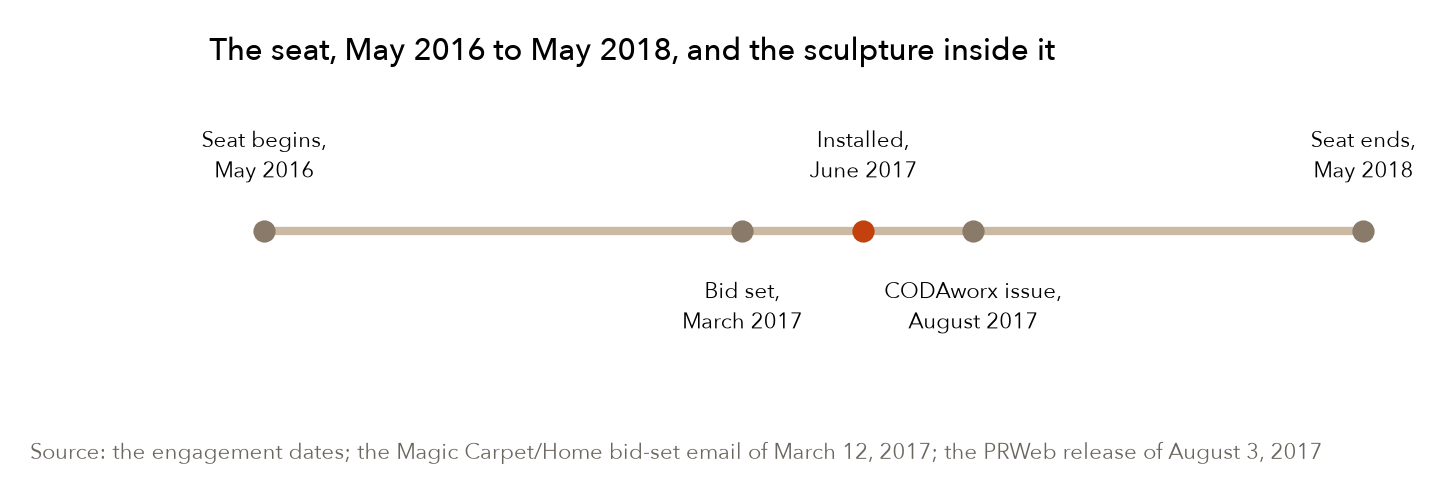
- Map the three parties before touching a schedule. Known: the campus had installations going up with an artist, a fabricator and facilities on each one, and no one whose word settled a disagreement. The question was what a three-party coordination seat structurally needs in order to function at all on a campus where mistakes are public. It produced the decision-rights grid in Attachment A: one responsible party per call, the artist on the vision, the fabricator on the fabrication budget, facilities on the building and its loads, and the seat on the schedule against the opening, on disputes between the parties, and on the accountable sign-off for public safety and the accessible path.
- Bid the sculpture at a normal rate. Known: the museum and the artist had the design and needed a fabricator who could work a live campus. The question I put to my own crew was whether we could build exactly what was drawn, on the hours and the site rules facilities would allow, and the answer was yes. It produced a bid set in March 2017 and a contract for the build. The rate was a normal one; what the job got beyond the rate was my attention.
- Treat the choreography as the deliverable. Known: the piece was simple and the process around it was not. The question, every day of the build, was what facilities needed to see from us to stop treating our crew as a risk. It produced a build that ran on the museum's hours, on the museum's site rules, with the sequencing worked around every other crew on campus. The install landed in June 2017.
- Hold the safety and access calls as the one place the seat is accountable. Known: on a public campus, egress width, clearances and the accessible path are the calls that end an opening if they are wrong. The question on each installation was who signs before the public walks in. It produced the rule the seat runs on: facilities walks the piece against a checklist before any opening, and the seat does not open without that signature. That is the one cell of the grid where an unpaid outside person holds accountability over the museum's own department, and it only works because the seat has no stake in the fabrication or facilities budgets.
- Review the bids and change orders on the other installations, and never price the review. Known: after the sculpture, the museum's other installation paperwork came to me to read with nobody from the museum in the room. The question I asked myself was what I was being paid in, since it was clearly not money. The answer was access and standing, and the decision was to take those in the currency they came in rather than try to convert them.
- Let the term end as a term. Known: standing of this kind is granted for a while, and a volunteer who overstays it becomes a fixture nobody asked for. The seat closed in May 2018 with the term, and the sculpture stayed where we put it.
| The call | Who is responsible | What the seat does |
|---|---|---|
| Artistic vision and design intent | The artist | Is told; never rules on it |
| Fabrication budget and materials | The fabricator | Is consulted; holds no stake in it |
| Building systems and structural load | Facilities | Is consulted; commissions an independent check when two estimates disagree |
| Public safety and the accessible path | Facilities signs; the seat is accountable | Holds the opening until the walkthrough is signed |
| The install schedule against the opening | The seat | Runs it, and escalates when float runs out faster than the calendar |
| Disputes between the parties | The seat | Hears both, gets a number from someone paid by neither, rules on the number |
What it produced
The one thing a reader can check is the sculpture. Magic Carpet/Home was installed in June 2017 for Home, So Different, So Appealing, and CODAworx, the network and publication for commissioned art, chose it for its Interactive Art issue in August 2017; the press release is public and names Tellus Build as the fabricator. The feature credits the artist's work and the build, which is as it should be. The seat has no press. That is the nature of a seat whose whole job is that nothing goes wrong in public.
What the seat produced is harder to photograph, so I will say it plainly. Coordination coverage across the campus's installations for the length of the term, with no headcount added and no paid line opened, and a set of operating rules for the role that the museum did not have to write. Attachment A is that charter as I would hand it to a museum or an owner setting up the same seat: who decides what, the walkthrough gate, the independent engineer rule, the escalation test, and the one condition on compensation that makes any of it hold.
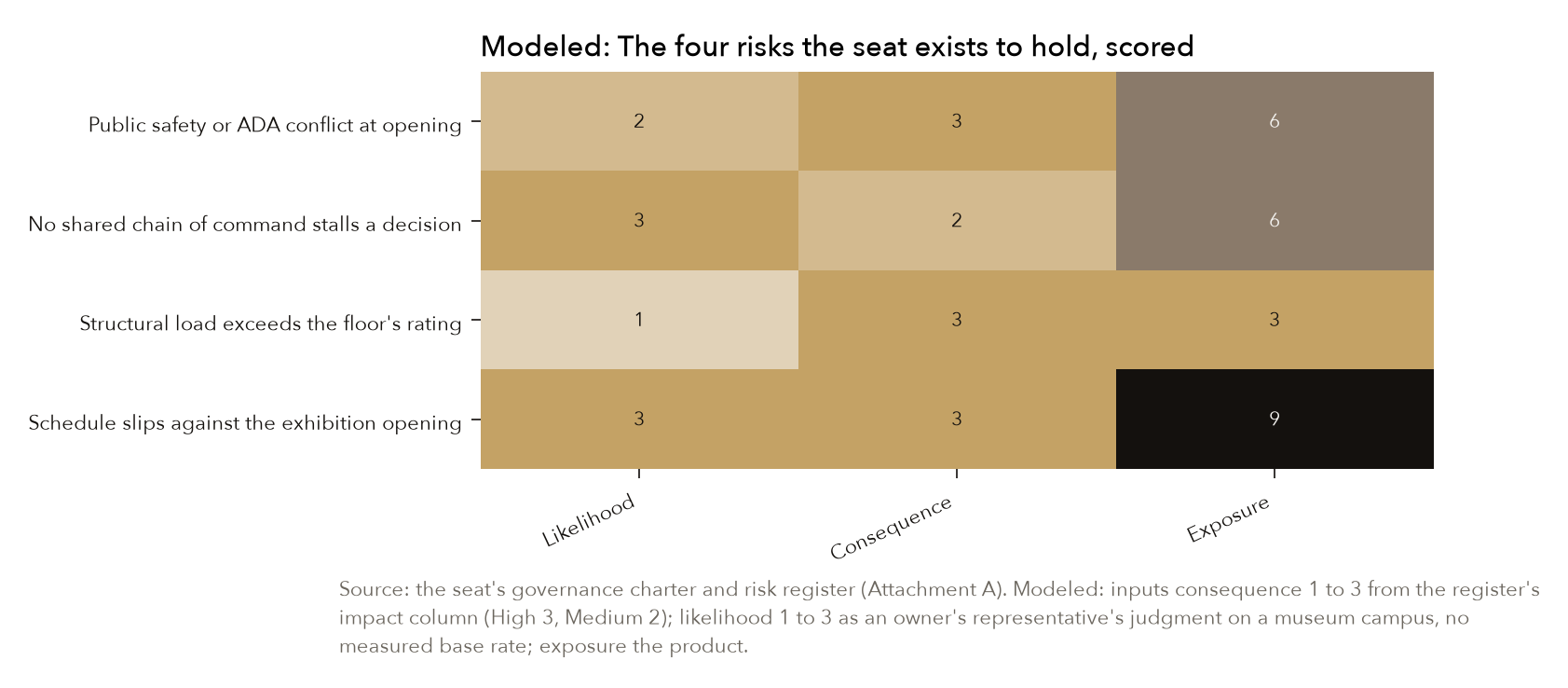
The grid is the register the seat runs against, scored. Two things about it matter more than the numbers. The structural load row sits low on likelihood because the fix is procedural: a licensed engineer, paid on a line none of the three parties controls, puts the floor's rating in writing before fabrication is final, and the seat rules on that number rather than on either party's estimate. The schedule row sits high because an exhibition opening is the one date on a museum campus that does not move, so every other risk is really a schedule risk in disguise.
What we kept, replaced and installed
We kept the museum's facilities process. It is conservative for a reason, and the seat's job was to work inside it and sign against it, never to waive it. We kept the artist's design intent as the fixed point on every installation; the seat was told about design, never asked to rule on it. And we kept the exhibition calendar as the clock everything else answered to.
We replaced one idea, and it is the idea every contractor carries, me included: that a coordination role has to be paid to have standing. Every owner's rep seat I had held before this one was paid by the owner, and the owner's money is what made the tie-break stick. That logic fails on a public campus with three parties, because there is no single owner whose money settles anything; the museum's facilities budget is one of the three interests in the room. A fee from any of them turns the tiebreaker into a fourth party. It had to change here, and early, because the installations were going up on a live calendar and the first disagreement was going to land before any written arrangement caught up with it.
We installed two things. The first was the seat itself, with its decision rights written down so that the artist, the fabricator and facilities each knew which calls were theirs and which were mine. The second was the walkthrough gate before any opening, the single place the seat is accountable rather than consulted, and the rule that the gate opens on nobody's word except facilities' signature.
The rule for a tiebreaker seat
- The seat is paid by none of the parties it decides between. Unpaid works; a fixed fee from the institution itself, on a line none of the parties controls, works; anything else ends the seat.
- One responsible party per call. The seat is told about vision, consulted on budget and building, and accountable only for the schedule against the opening, disputes between the parties, and the sign-off before the public walks in.
- When two parties' estimates disagree, get a number from someone paid by neither and rule on the number.
- Nothing opens without the facilities walkthrough signed. The seat cannot waive it.
The logic that had to change: standing on a public campus is granted for independence, and independence is the one thing a fee removes. Attachment A is the charter in full.
What it cost to hold the line, and what I would watch
It cost the term's review work, unpaid, on installations I did not build, time that could have gone to paid jobs elsewhere. It cost the discipline of never asking the museum to pay for it, which was harder than it sounds, because the contractor's reflex is to convert standing into a fee and the reflex does not go away because you have decided against it once. On the sculpture, it cost attention spent on choreography that no line item covered. And it cost exposure: an unpaid seat accountable for a public-safety sign-off carries no contract and no indemnity, which is why the walkthrough gate exists and why the museum's own risk, and never the volunteer's, has to sit behind that call in writing.
What I watched for, to know I was wrong, was the museum putting someone back in the room. If the paperwork had stopped coming unsupervised, the standing was gone whether or not anyone said so. It kept coming. What I would watch, on any seat of this kind:
- Whose money. The first question on any tiebreaker role is who pays the tiebreaker. If the answer is one of the parties, there is no tiebreaker.
- The small job. Institutions extend standing on what they have already watched you do inside their walls. Reputation from outside does not transfer in. Do the small job as if it were the whole relationship.
- Which currency. Read what the counterparty is actually paying you in. If it is access and standing, take them in that currency and do not try to convert them.
- The two calls. On a public campus, safety and the accessible path are the calls that end an opening. Know who signs, and do not open without the signature.
- The written grant. Standing exercised on a handshake is real while it lasts and gone the day it is questioned. Get the scope, the checklist and the institution's risk exposure on paper.
- The term. A volunteer seat is granted for a while. Leave when the term ends, and leave the work where you put it.
The result, in short
Magic Carpet/Home was installed in June 2017 for the exhibition Home, So Different, So Appealing, and CODAworx chose it for its Interactive Art issue that August; the press release is public and names Tellus Build as the fabricator. What the seat produced is harder to photograph: coordination coverage across the campus's installations for the length of the term, with no headcount added and no paid line opened, and a set of operating rules for the role that the museum did not have to write.
A slice of the project list
A few related projects.
- LA Clippers Practice Facility: general contracting and design on a building that never closed (2017 to 2018)
- Habitat for Humanity: construction partner and in-kind donor across three chapters (2007 to 2016)
- Greensburg, Kansas: preconstruction and general contracting lead on a town's green rebuild after an EF5 tornado (2007 to 2008)
- Village San Juan: property operations for a homeowners association (2015 to 2022)
- Ghana, 1,000 acres: master plan and design proposal for a new community in Ghana's Volta Region (2026)